 WhatsApp

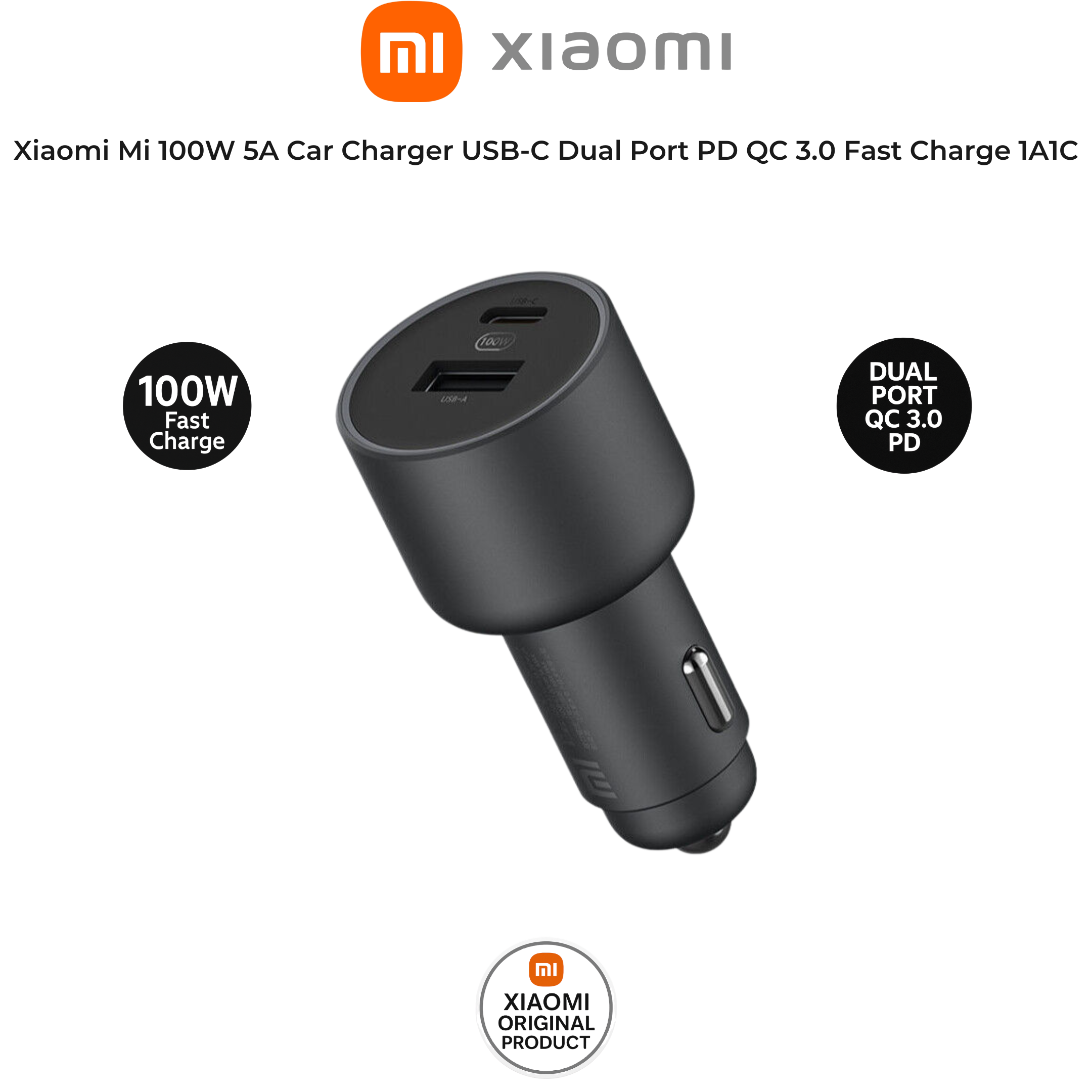
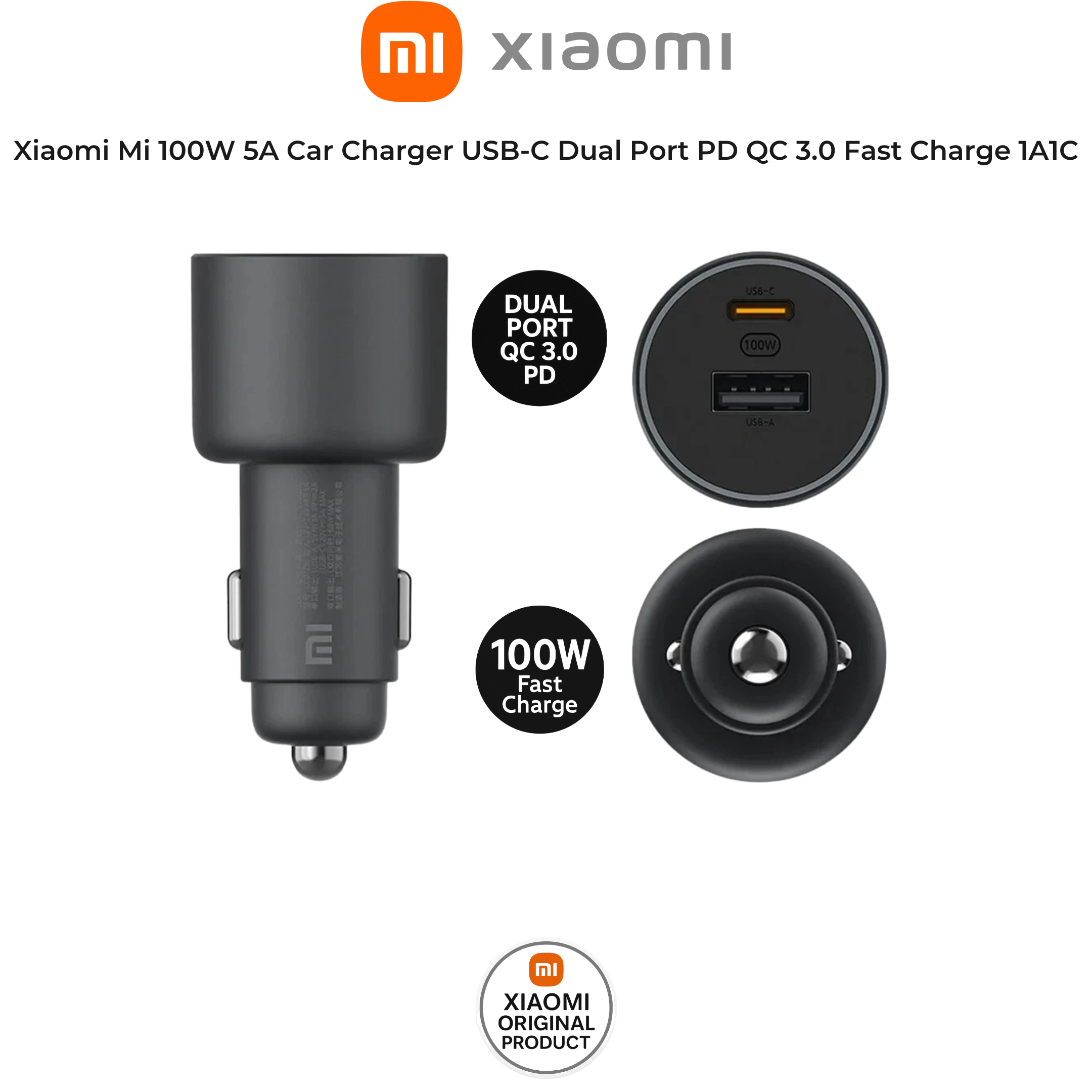
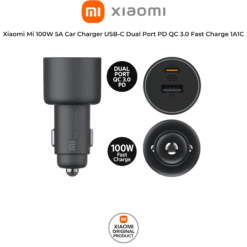
Xiaomi Mi 100W Car Charger

£15.88
In stock
| Delivery | 4–5 working days · Fully tracked |
| Returns | 30 Day Returns |
| Warranty | 12-Month Warranty |
| Payment | Visa · Mastercard · Apple Pay · Klarna |
The Xiaomi Mi 100W car charger — CC07ZM, a dual-port 12V car charger delivering up to 100W from the USB-C port on its own, or 68W across both ports together. USB-C Power Delivery 3.0 and USB-A Quick Charge 3.0, a ring LED indicator for night use, four-way circuit protection, and a 5A E-Marker USB-C cable included.
- ✓ USB-C 20V/5A — up to 100W on its own · 68W total when both ports are in use
- ✓ 5A E-Marker USB-C cable included — required to reach the full 100W
- ✓ PD 3.0 · QC 2.0/3.0 · FCP · Apple and Samsung fast charge protocols
- ✓ Ring LED indicator for night use · over-temperature, short-circuit, over-voltage and over-current protection
The Xiaomi Mi 100W car charger — CC07ZM, a dual-port 12V car charger delivering up to 100W from the USB-C port on its own, or 68W across both ports together. USB-C Power Delivery 3.0 and USB-A Quick Charge 3.0, a ring LED indicator for night use, four-way circuit protection, and a 5A E-Marker USB-C cable included.
- ✓ USB-C 20V/5A — up to 100W on its own · 68W total when both ports are in use
- ✓ 5A E-Marker USB-C cable included — required to reach the full 100W
- ✓ PD 3.0 · QC 2.0/3.0 · FCP · Apple and Samsung fast charge protocols
- ✓ Ring LED indicator for night use · over-temperature, short-circuit, over-voltage and over-current protection
The Xiaomi Mi 100W car charger is one of the few 12V chargers that can genuinely run a laptop rather than just topping up a phone. The USB-C port delivers 20V at 5A — 100W — which covers a USB-C laptop, a tablet, a phone at its maximum charging rate, or outdoor gear like a power bank or a torch. The USB-A port alongside it handles a second device on Quick Charge 3.0. One number is worth understanding before you buy, because it is the thing most listings gloss over: the 100W figure applies when the USB-C port is used on its own. Plug something into both ports and the combined output is 68W, shared between them. That is still substantial for a car charger, but it is not 100W plus another port’s worth. The 5A E-Marker USB-C cable in the box is not an accessory you can skip — a standard USB-C cable caps at 3A and will hold the charger to around 60W regardless of what it is capable of. Four protection circuits cover over-temperature, short circuit, over-voltage and over-current, and the ring LED around the body makes the socket easy to find at night.
100W Single · 68W Dual
Reading the Power Figures Correctly
The USB-C port negotiates up to 20V at 5A, which is 100W — the same ceiling as most USB-C laptop chargers, and enough to charge a compatible laptop at full speed rather than trickling it. Xiaomi quotes a Mi 10 Ultra going from empty to full in 25 minutes on this charger. The USB-A port runs separately at 5V/3A or 9V/2A depending on what is connected. The point that matters in practice is what happens when both are occupied: total output across the two ports becomes 68W, allocated between them rather than added together. So a laptop on USB-C alongside a phone on USB-A will not both charge at their maximum rate simultaneously — the laptop drops back to make room. If your main use is charging one device fast, use the USB-C port alone and you have the full 100W. If you routinely charge two devices in the car, plan around 68W shared, which is still comfortably enough for two phones or a tablet and a phone. Input is 12V–24V at up to 9.5A, so the charger works in both a car and a truck or van running a 24V system.
E-Marker Cable · Why It Is Included
The Cable Is Part of the Specification
The USB-C specification caps ordinary cables at 3A. To carry 5A safely, a cable must contain an E-Marker chip — a small controller that identifies the cable to the charger and the device and declares that it is rated for the higher current. Without that declaration the charger will not attempt 5A no matter what it is capable of, because it has no way to know the cable can handle it. At 20V and 3A the ceiling becomes 60W rather than 100W. This is why the E-Marker cable is supplied in the box rather than sold separately, and why substituting a generic USB-C cable quietly costs you 40W. If you later replace the cable, look specifically for one rated at 5A or 100W — the marking is usually printed on the connector housing or the packaging. Beyond the cable, the charger supports the common fast-charge protocols so it works properly with devices from different manufacturers: USB Power Delivery 3.0 for laptops, iPhones and most modern Android phones; Quick Charge 2.0 and 3.0 and Huawei’s FCP on the USB-A side; plus Apple 2.4A, Samsung 5V/2A and standard DCP for older devices.
Ring LED · Four-Way Protection
Safety and Everyday Use
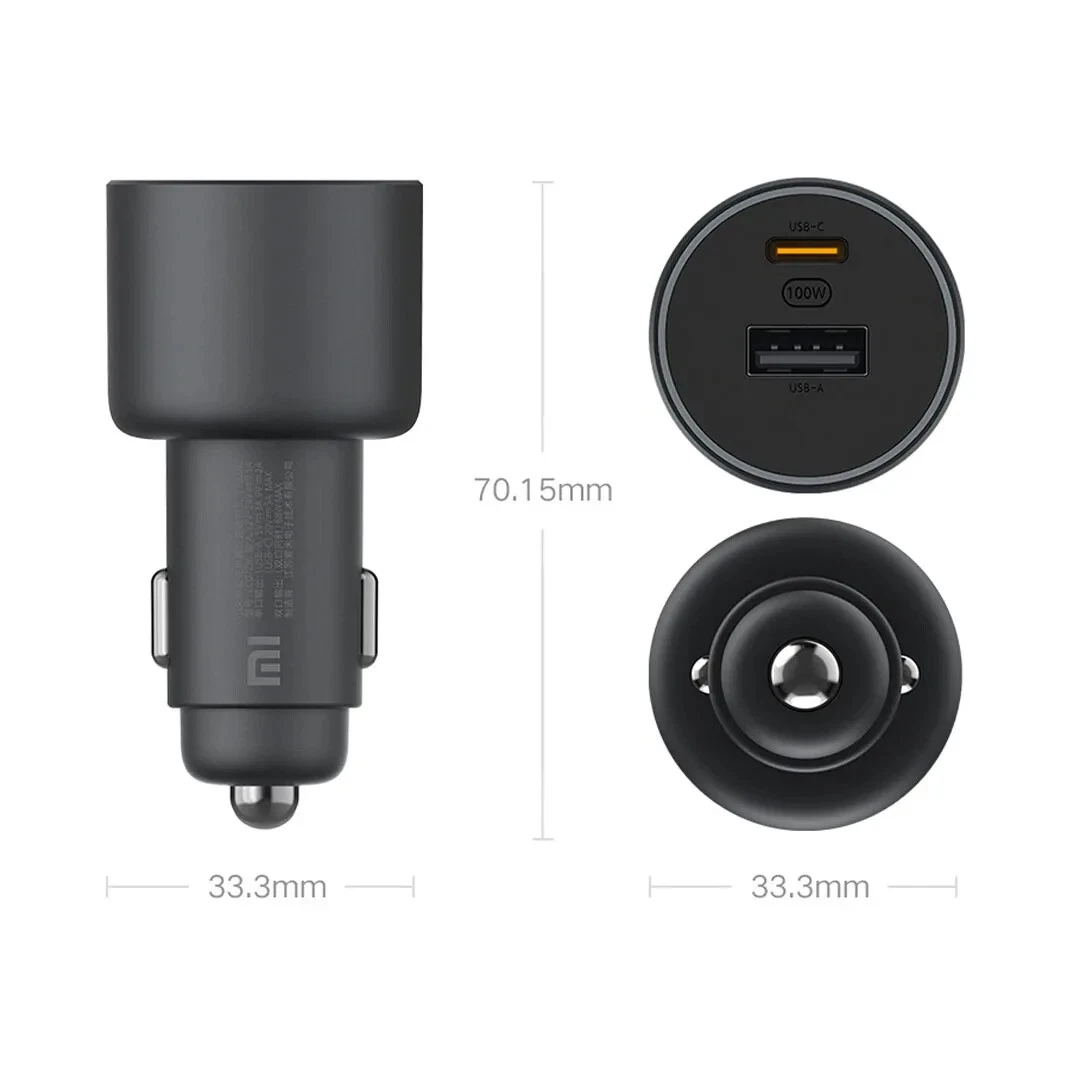
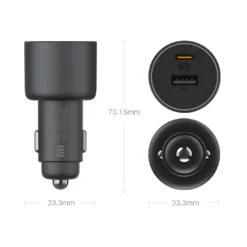
Pushing 100W through a 12V socket generates real heat, and a car interior in summer is already a hot environment, so the protection circuitry here is doing more than ticking a box. Over-temperature protection reduces or cuts output if the charger exceeds its safe operating range — the failure mode that matters most in a car parked in the sun. Over-voltage protection guards against the spikes that vehicle electrical systems produce when starting the engine or switching heavy loads. Over-current and short-circuit protection cover a faulty cable or device. The ring-shaped LED around the charger body lights the socket area, which sounds like a small thing until you are reaching for the socket in the footwell at night. It displays white on standby so you can see at a glance that the charger is seated and receiving power. The body measures 75.15 × 33.3 × 33.3mm, sitting proud of the socket enough to grip and remove easily without protruding far into the cabin. One practical check before you buy: 100W output draws around 9.5A from a 12V socket, so if your car’s accessory socket is on a 10A fuse the charger will run near that limit at full load. Most modern vehicles fuse the socket at 15A or 20A and have no issue.
Right choice if you…
✔ Need to charge a USB-C laptop in the car — 100W matches most laptop mains chargers
✔ Want a charger that works properly across brands — PD 3.0, QC 3.0, FCP, Apple and Samsung protocols
✔ Charge two devices in the car — dual port at 68W shared covers a phone and a tablet comfortably
✔ Drive a van or truck on a 24V system — input range covers 12V to 24V
Consider something else if…
✖ You expected 100W on both ports at once — the combined figure is 68W; 100W is available from USB-C only when the USB-A port is unused
✖ Your laptop needs more than 100W — high-power workstations and some 16-inch laptops draw 130W or more and will charge slowly or not at all
✖ You only ever charge one phone — a 30W or 45W car charger costs less and does that job just as well
Technical Specifications
| Brand | Xiaomi |
| Model | Mi 100W Car Charger (1A1C) |
| MPN | CC07ZM |
| Input | 12V – 24V / 9.5A |
| USB-C Output | Up to 20V / 5A — 100W max (single port) |
| USB-A Output | 5V / 3A · 9V / 2A |
| Dual Port Total | 68W max (shared between ports) |
| Protocols | USB PD 3.0 · QC 2.0 / 3.0 · FCP · Apple 2.4A · Samsung 5V/2A · DCP |
| Cable Included | USB-C to USB-C with E-Marker chip (5A rated) |
| Indicator | Ring-shaped LED · white on standby |
| Protection | Over-temperature · short-circuit · over-voltage · over-current |
| Dimensions | 75.15 × 33.3 × 33.3mm |
| Warranty | Manufacturer warranty (Xiaomi) |
In the Box
Xiaomi Mi 100W car charger (CC07ZM)
USB-C to USB-C cable with E-Marker chip (5A)
User manual
Frequently Asked Questions
Do I get 100W from both ports at the same time?
No. The 100W figure applies to the USB-C port used on its own, with nothing in the USB-A port. As soon as both ports are occupied, the total output across the two becomes 68W, shared between them. This is normal for dual-port chargers and is a limit of the total power the unit can convert, not a fault. If you need the full 100W for a laptop, use the USB-C port alone.
Can I use my own USB-C cable instead of the one supplied?
You can, but you will lose power unless it is a 5A cable. Ordinary USB-C cables are built to the 3A limit in the USB specification, which caps output at around 60W. Reaching 100W requires a cable containing an E-Marker chip that identifies it as 5A-rated — the charger will not attempt the higher current otherwise. The supplied cable has this chip. If you replace it, look for one marked 5A or 100W.
Will it charge my laptop?
If your laptop charges over USB-C Power Delivery and its mains charger is rated at 100W or less, yes — this will charge it at full speed. That covers most 13 and 14-inch laptops and many 15-inch models. Laptops shipped with a 130W or larger charger will still receive power but will charge slowly, and may drain while running demanding workloads. Check the wattage printed on your laptop’s original charger.
Will it work in my car, or does it need anything special?
It fits a standard 12V accessory socket, the type formerly called a cigarette lighter socket, and also works on 24V systems in vans and trucks. At full 100W output it draws around 9.5A from a 12V supply, so if your vehicle’s accessory socket is protected by a 10A fuse it will be running close to that limit under heavy load. Most modern cars fuse the socket at 15A or 20A. Your vehicle handbook or the fuse box diagram will confirm the rating.
Does it work with iPhone and Samsung, or only Xiaomi?
It works with all of them. The charger supports USB Power Delivery 3.0, which is what iPhones and most Samsung Galaxy phones use for fast charging, alongside Quick Charge 2.0 and 3.0, Huawei FCP, Apple 2.4A and Samsung 5V/2A on the USB-A side. Each device negotiates the protocol and voltage it wants, so you get the fastest rate that device supports rather than a fixed output.
Condition
Brand New — Retail Packaging
Warranty
Manufacturer warranty (Xiaomi)
Delivery
4–5 Working Days · Fully Tracked
Also Available at maibo
Browse the full chargers and cables range at maibo.
Only logged in customers who have purchased this product may leave a review.
Related products
Charging & Cables
Charging & Cables
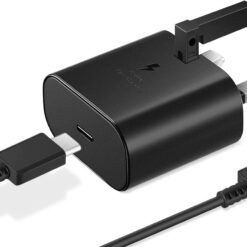
Samsung 25W USB-C Wall Charger Set – EP-TA800 – Black (UK Plug)
Charging & Cables
Charging & Cables
Reviews
There are no reviews yet.