 WhatsApp

Insider
25W Wireless Charging: Why Your Phone Almost Never Gets It
25W Wireless Charging: Why Your Phone Almost Never Gets It —
Four Things Have to Agree First
A wired charger negotiates with two parties: the phone and the cable. A wireless charger negotiates with four, and the one most buyers never think about is the case on the back of the phone. Get three right and miss one, and a 25W pad quietly delivers 5W all night without telling you.
Qi2 wireless standard
charge averaged in practice
same charge over a cable
Wireless charging spent a decade as the slow option you used overnight. That changed in the last two years: the Wireless Power Consortium raised the Qi standard twice, and 25W wireless charging is now printed on boxes from Apple, Samsung, Google and a long tail of third-party pads. On paper it is quick enough to be useful during the day rather than only in bed.
The questions we get from buyers about 25W wireless charging tell a different story. Somebody buys a 25W magnetic charger, plugs it into the adapter already on the bedside table, puts the phone on it, and the phone charges slower than the cable it replaced. Nothing is broken. Three of the four conditions for 25W were met and the fourth was not, and no part of the chain is designed to tell you which one failed.
Below: what Qi, Qi2 and Qi2 25W actually mean, the four conditions in order, the extra condition Samsung has quietly added, and what independent measurements show about 25W wireless charging speed, energy and heat once everything does line up.
Qi, Qi2 and Qi2 25W: Three Numbers, Not Three Generations
Original Qi is the standard behind every flat pad sold since roughly 2012. Its baseline is 5W, with an extended profile that reaches 15W in theory. In practice, phones treat generic Qi pads conservatively, and the gap between the rating on the box and the power reaching the battery is the widest anywhere in charging.
Qi2 is the change that matters, and the change is not the wattage — it is magnets. Qi2 built Apple’s MagSafe alignment ring into the open standard, so the coil in the charger and the coil in the phone line up every time instead of approximately. Qi2 is rated up to 15W. The newer tier, sold as Qi2 25W and sometimes written Qi2.2, raises that to 25W and keeps the magnets. A Qi2 25W charger is backward compatible: put a 15W Qi2 phone on it and you get 15W, not an error.
So 25W wireless charging sits at the top of three tiers, in rising order: Qi at 5W to 15W depending on how generous the phone feels, Qi2 at 15W with magnets, Qi2 25W at 25W with magnets. Everything on a shelf today is one of those three, whatever the marketing copy on the box calls it.
“The real advance in Qi2 was never the wattage. It was removing the possibility of putting the phone down slightly wrong.”
— John Matt, Maibo
The Four Conditions for 25W
- 1The phone has to support 25W wirelessly
Fewer phones do than the shelf implies. On Apple’s side, 25W belongs to iPhone 17, 17 Pro and 17 Pro Max, plus iPhone 16 Plus and 16 Pro Max; the iPhone 16 and 16 Pro reach 22.5W, the iPhone Air 20W, and iPhone 15 and earlier stay at 15W. On Samsung’s, only the Galaxy S26 Ultra reaches 25W — the S26+ does 20W and the standard S26 does 15W. On Google’s, the Pixel 10 Pro XL is the 25W model. Everything else on the current shelf tops out lower, and will take the highest tier it supports from a 25W charger without complaint.
- 2The charger has to be certified at that tier
A magnetic pad is not automatically a Qi2 pad. Plenty of accessories pair a ring of magnets with an ordinary Qi coil behind it: the phone snaps on satisfyingly and then charges at 5W. The specification tier is the thing to read, not the word “magnetic”. Apple’s own pucks carry model numbers for exactly this reason — the 25W-capable versions are A3502, A3503, A2580 and A3250, and an older puck looks identical from across a desk.
- 3The mains adapter has to be big enough — and this is the one that catches most people
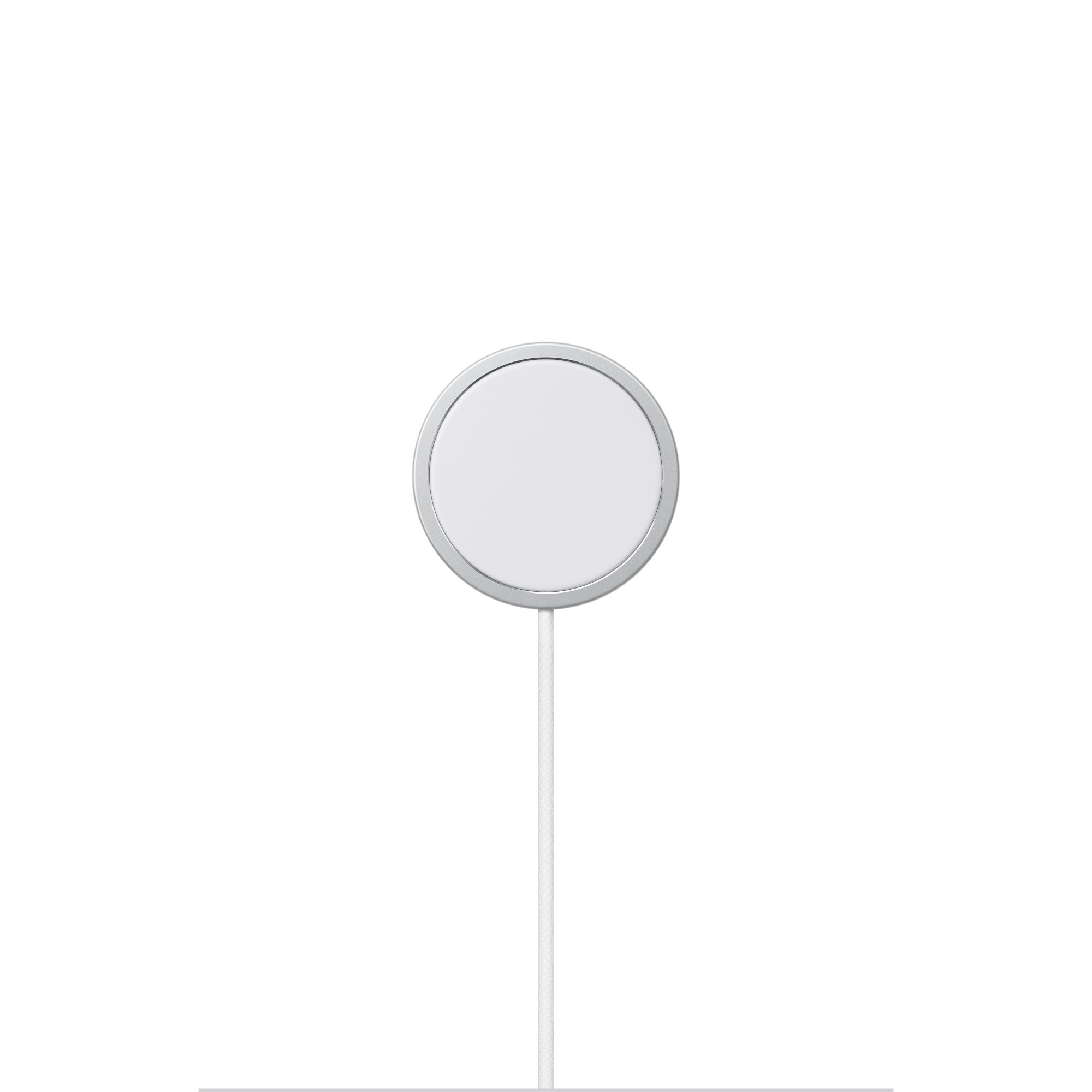
Wireless chargers are sold as a puck and a cable, with no plug. Apple is explicit about what goes behind it: 15W needs a 20W or greater adapter, and 25W needs a 30W or greater adapter rated at 15V/2.0A or higher. Plug a 25W-capable puck into the 20W adapter from an older iPhone and the phone charges at 15W — correctly, quietly, and at 60% of the advertised figure. The Apple MagSafe Charger with the 2m cable is a clear case in point: it will do 25W on an iPhone 16 or later, and the single thing that decides whether it does is the adapter you already own.
- 4The two coils have to be aligned, and the case decides that
Power crosses an air gap here, and the gap is unforgiving. iFixit’s testing found that poor alignment on a pad can cut a wireless charger’s efficiency roughly in half. Magnets solve this on phones that have them. On phones that do not, a thick case, an off-centre coil or a card holder between phone and pad is enough to drop the charge to a trickle. Apple also warns that credit cards, security badges, passports and key fobs do not belong between the phone and a magnetic charger at all — the magnets and the coil can damage magnetic strips and RFID chips.
Samsung Has Added a Fifth Condition
The Galaxy S26 series supports Qi2 25W on the Ultra, which sounds like straightforward good news until you notice that the S26 phones have no magnets built into them. Alignment therefore depends entirely on a magnetic case — and that is where it gets complicated.
The case maker dbrand, responding publicly to a customer, said its S26 Ultra cases have the magnets in the correct Qi2 positions but lack a proprietary handshake that Samsung requires before the phone will accept 25W — a Samsung-specific flavour of the specification it had not been able to replicate. On that account, reaching 25W on an S26 Ultra needs four things rather than three: a 25W-or-greater adapter on a single port, a Qi2 25W charger, and a magnetic case that satisfies Samsung’s handshake, not merely one with correctly placed magnets.
We have not tested that handshake ourselves, and Samsung has not published a compatibility list, so treat it as a reported constraint rather than a measured one. The practical consequence is the same either way: on a Galaxy, the case is part of the charging specification, and a third-party magnetic case is not a safe assumption. Apple and Google owners can skip this entirely — the magnets are in the phone.
What Happens When All Four Do Line Up
This is the part the box never covers. Android Authority ran a Pixel 10 Pro XL — a phone with built-in magnets, on a certified Qi2 25W charger, correctly fed — through a full charge and measured it. The peak figure appeared for a few minutes at the start, then the charge settled at roughly 10W for most of its length. A full charge took 135 minutes wirelessly against 77 minutes over USB-C. The phone sat at about 38°C for more than two hours, where the cable charge hit a similar peak and then cooled after half an hour.
The same testing found the older generation of pads is worse than most people assume: on 10W and 15W standard Qi chargers, the Pixel 10 Pro and Pro XL dropped to around 3.6W. A 15W Qi pad bought a few years ago is not a slightly slower Qi2 charger — it is a different category of device.
Then there is the energy. Wireless charging loses 20% to 30% of the power it is given as heat before anything reaches the battery. A 2020 study measured about 21Wh to fill a phone wirelessly against about 15Wh over a cable — roughly 40% more — and iFixit’s 2024 MagSafe measurement came to about 36% more. For one phone that is a few pence a year and nobody should reorganise their life around it. It does matter for power banks, where a magnetic Qi2 bank delivers roughly half its rated capacity to the phone, while the same bank over USB-C delivers around 20% more charge than it does wirelessly.
None of this argues against wireless charging. It argues for buying it for what it is actually good at. Putting a phone down on a desk fifteen times a day without handling a connector is genuinely convenient, and the slower, cooler profile is perfectly suited to a bedside table where nobody is watching the clock. Where it falls down is as a replacement for the cable when you are in a hurry — and that is exactly the job the 25W figure on the box seems to promise. For anything time-critical, the cable still wins, and the amp rating on that cable is what determines by how much.
Check the phone’s own ceiling first. Paying for 25W on a 15W phone changes nothing.
Read the tier, not the word “magnetic”. Qi, Qi2, or Qi2 25W — magnets alone mean nothing.
Count the adapter in the price. 15W needs 20W+; 25W needs 30W+. Pucks ship without a plug.
Galaxy owners: the case is part of the spec. Magnets in the right place may not be enough.
Take the card holder off. Cards and badges between phone and pad are a hazard, not a slowdown.
Prefer a fan or a stand for daytime charging. Sustained wattage is a thermal problem, not an electrical one.
Keep a cable for anything urgent. Wireless is the convenient charge, not the fast one.
25W wireless charging is real, and it is also the narrowest claim in charging: it needs a phone that supports it, a charger certified at that tier, a 30W-or-greater adapter behind it, and coils that line up — with a compatible case as a fifth requirement on a Galaxy. Miss one and nothing warns you; the phone simply charges slower and stays warm. Buy a wireless charger for the convenience of putting the phone down, and buy the adapter that matches it in the same order. When speed is what you need, reach for the cable — on measured tests it was still nearly twice as fast.
Genuine wireless chargers, adapters and the cables that feed them — same-day dispatch before 15:00.
Qi2
MagSafe
Galaxy S26 Charging
Pixel 10
Buyer Education
More from the Journal
Keep reading